Intelligence
Ask the case.
AI in Duologa works inside the clinical record. It talks with you about each client’s history, organizes what was said between sessions and points out what deserves your attention, always with the source beside it and the decision with you.
The platform uses artificial intelligence to support administrative and professional work. It does not provide therapy, issue diagnoses or replace the professional’s judgment.
Questions like these, in a couples case
- Which themes come up most often in the sessions?
- How does the couple describe their cycle of fighting?
- In which sessions did the story of Ricardo’s first marriage come up?
AI Listening
Talk with the history of each course of care.
Ask about a client and AI Listening searches the sessions, the clinical record and the case records. Every sentence in the answer carries its source, and one click takes you to the excerpt it came from.
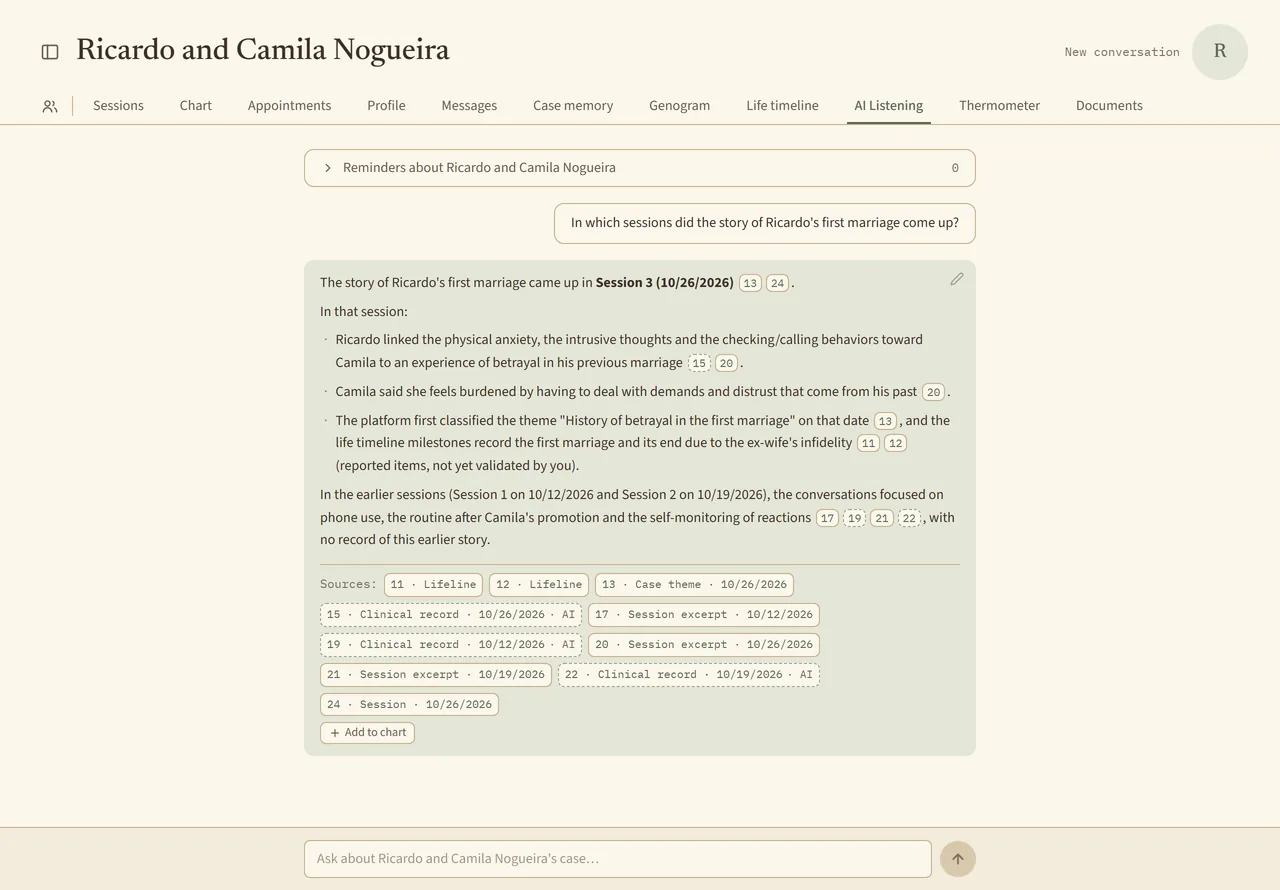
- 1Every sentence carries the number of its source. One click takes you to the session excerpt or the record it came from.
- 2The sources: sessions, case themes, Life timeline, clinical record. Dashed means AI text you have not reviewed yet.
- 3The conversation stays in AI Listening. Only what you add goes into the clinical record, as a draft marked as AI.
What it reads, only for the open client
- The session transcripts (in Portuguese only, for now)
- Your notes, including handwritten ones on the tablet once converted to text
- The clinical record and the Case memory
- The genogram, the Life timeline and the scales
- The text of attachments
If you don’t record, you can still talk with the case: AI Listening uses your notes and the clinical record.
The supervisor can also talk to AI Listening, only about the cases shared with them.
Recording and transcribing the session audio only happen with the client’s consent.
Between sessions
Pick up what was said and see what keeps coming back.
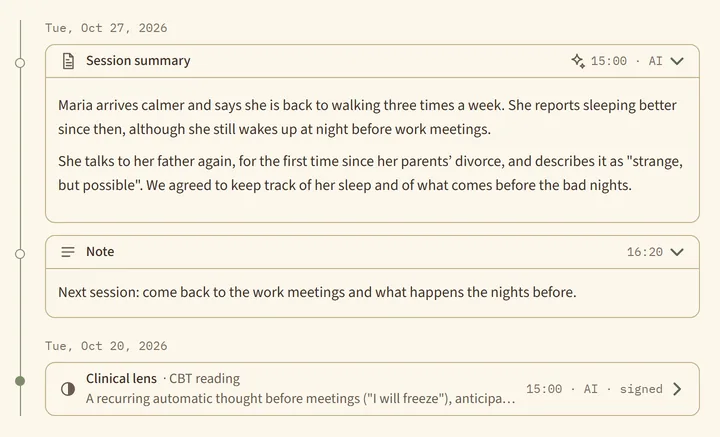
After each transcribed session, the platform organizes what matters for the next one, always with the original words.
- Case memory
- The themes that keep coming back, how many times they came up, what changed and what hasn’t come up in a while.
- Session index
- Agreements, pending items and open questions, each one with the excerpt where it was said.
- Clinical record
- The session summary goes in as an AI record, for you to edit. Analyses by approach wait for your approval.
Recording and transcribing the session audio only happen with the client’s consent.
Points of attention
Points of attention for you to review.
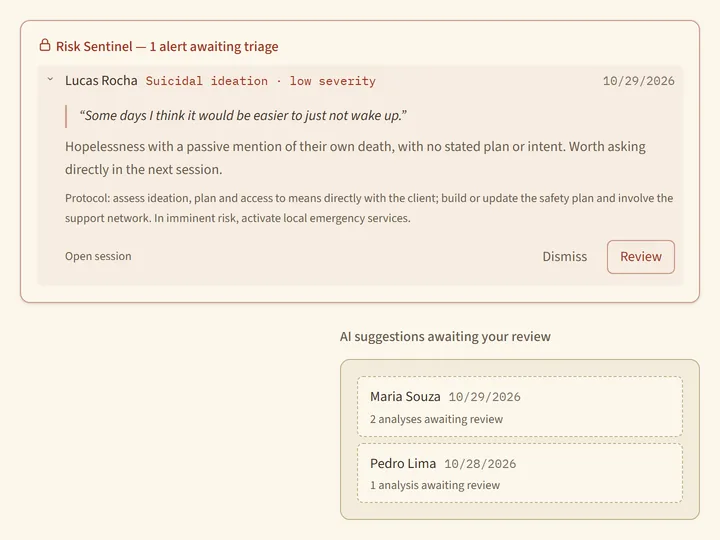
AI reads the transcribed sessions and sets aside what calls for your attention. Nothing goes to the client: the assessment is always yours.
- Risk Sentinel
- Highlights excerpts with signs of risk, with the reasoning and the protocol beside them, for your triage.
- Suggestions to review
- AI analyses of each session wait for your review in a panel on the Home screen.
- Genogram questions
- When AI is unsure about a family detail, it records the question for you to answer.
The Sentinel works only on the transcript and may miss a sign: it does not replace your own listening.
Recording and transcribing the session audio only happen with the client’s consent.
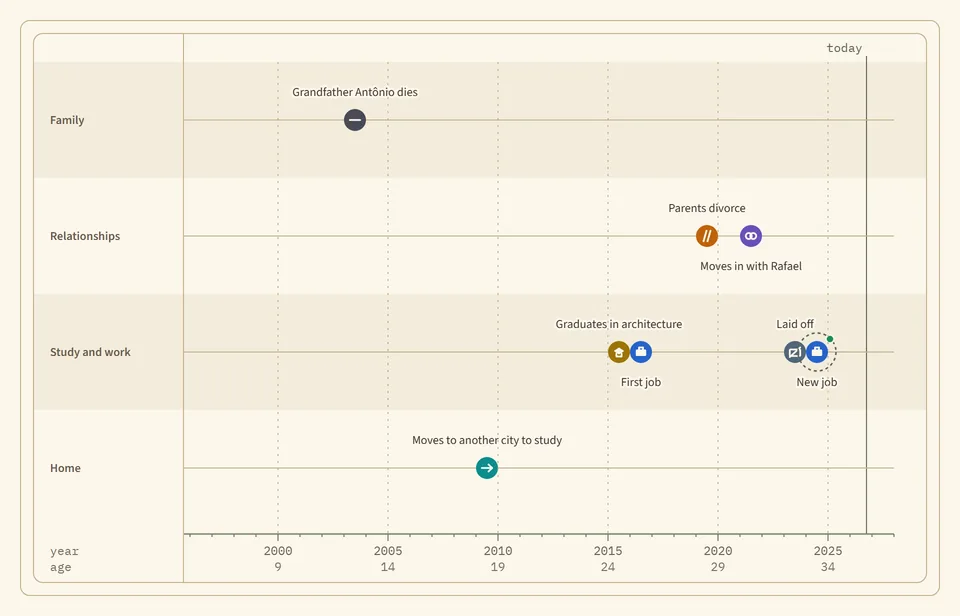
Genogram and Life timeline
Build the genogram with AI. Check it and edit it.
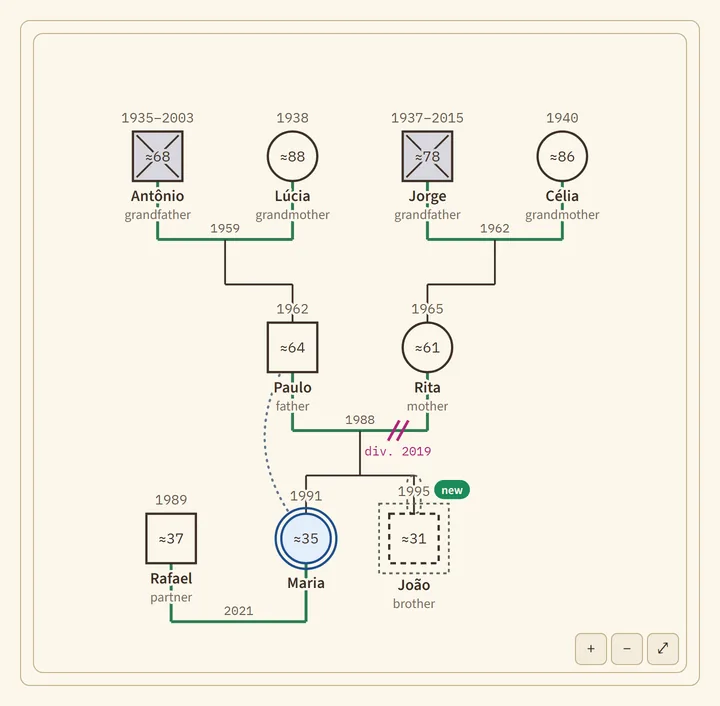
From the transcribed sessions, AI records people, family ties and life milestones with the exact excerpt and the degree of certainty. You validate, correct and complete; what you have validated, AI does not change.
- Ask for changes the way you would ask a colleague: AI shows how the drawing will look, and nothing changes until you apply it.
- The relationships between people, only you draw: AI never draws a relationship.
- What AI recorded and you have not checked yet appears dashed in the drawing.
- The genogram exports to PDF or image, with options to hide sensitive data and use initials.
Recording and transcribing the session audio only happen with the client’s consent.
Clinical records with AI
AI organizes what was said. You decide what stays.
Everything AI produces is a suggestion for your own reading. The search, AI Listening, the Risk Sentinel and the genogram show the excerpt each point came from.
- Session summary in the record
- When processing ends, the summary goes into the clinical record marked as an AI record, for you to edit; once you edit it, the mark goes away. The account can turn this off and record only what you approve.
- Analyses by approach
- Readings of the session in CBT, psychoanalysis, humanistic (person-centered), ACT, DBT or social constructionism, or guided by your own instructions. Each one starts as a draft: you reject, edit or approve.
- Continuous clinical record
- A timeline by day with notes, summaries, handwritten notes, documents and attachments in PDF or image.
- Guiding Thread and Case memory
- Ask "how has the insomnia evolved?" and get the exact excerpts, session by session; one click opens the conversation at the right spot. Case memory gathers the themes that keep coming back.
- AI Listening
- Talk about a client with an AI that has read the sessions and the clinical record. It cites the source of each statement, for you to check; without an excerpt to support it, it says it did not find one. No need to copy the case into a general-purpose AI: the conversation is stored, encrypted, and only you can see it; the questions go into the audit trail and nothing is used to train AI models.
- Genogram and Life timeline
- The family and the milestones of a life, recorded from the sessions with the excerpt and the degree of certainty. You validate and complete; the relationships between people, only you draw. The genogram exports to PDF or image.
- Thermometer
- PHQ-9 and GAD-7 applied in session or through a link the client answers on their phone, with a chart of how they evolve. They are screening and follow-up scales, not diagnostic tools.
- Risk Sentinel
- Points out, for you to assess, excerpts from the session that may indicate risk, with a suggested course of action. Nothing is sent to the client or to anyone else. It can miss a relevant situation: it does not replace your own risk assessment or emergency care.
- Documents
- Reports, opinions and statements in the structure required by Brazil’s psychology board (CFP), with gaps where information is missing. Once signed, the document does not change. AI does not write psychological assessment reports, on purpose.
AI suggests, you decide: analyses and documents only go into the clinical record with your approval. The only exception is the session summary, which goes in marked as an AI record until you edit it.
Born in the age of AI
Designed for AI from day one, with confidentiality built in.
AI and the protection of clinical content were designed together, not one after the other.
Inside the clinical record
AI works where the case already is. You don’t copy anything into a general-purpose AI.
The practice’s own key
Transcripts, clinical records and analyses are encrypted with your practice’s own key and stored in Brazil.
Logged, never trained on
Conversations with AI Listening go into the audit trail, and clinical content does not train any AI model.
Who can see
It follows the clinical record’s rule: it answers only about what you can open, and the front desk can’t reach clinical content through it either.
Searches and shows the source
It looks through the case piece by piece, the way you would search the records, and says where each sentence came from. Date calculations are done by the platform.
Off per client
For each client, you can turn AI off at any time: without the authorization, it does not work on that case.
Under the hood, AI Listening is an agent: faced with your question, it decides what to look up in the case, looks it up and only then answers, always within these rules.
Where we come from
Duologa was born from bringing together the long experience of mental health professionals and academics with the knowledge of artificial intelligence professionals.
Ask your own cases.
30 days free, no card. Sign in with your Google Account and start using it.